
Mwalimu :HAKIZIMANA Maurice
When asked why Rwanda does not have a legal minimum wage, the Prime Minister and Head of Government, Dr. Justin Nsengiyumva, replied:
“When we increase production, salaries will increase by themselves.”
By themselves? Really?
No. Things do not happen by themselves. They are planned. It is the responsibility of the government to develop roadmaps that define the actions to be taken, the methods of implementation, the timelines, and the expected results.
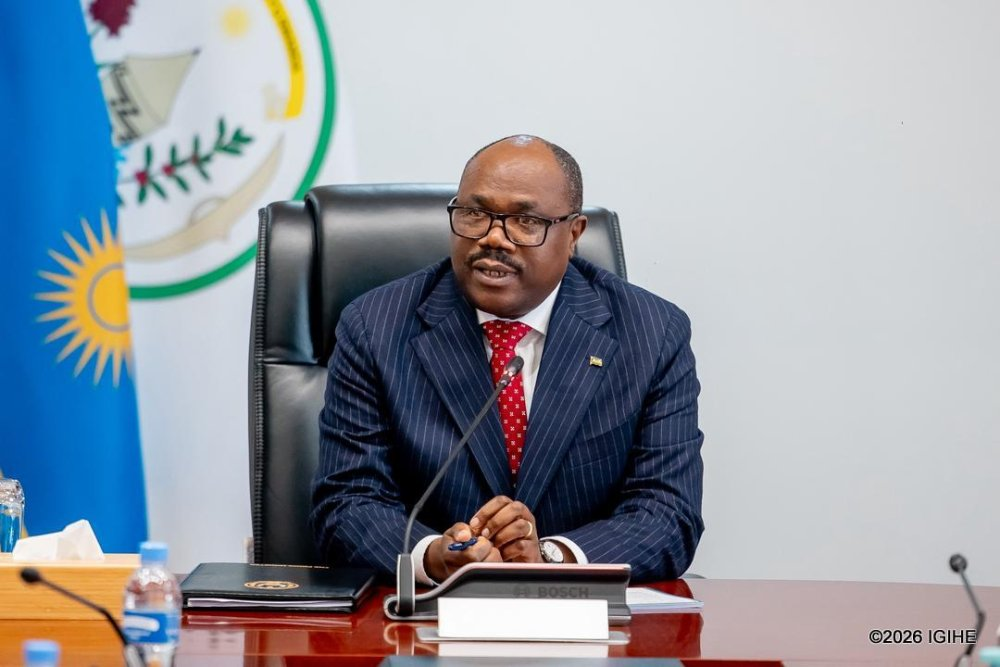
Rwanda’s Prime Minister and Head of Government, Dr. Justin Nsengiyumva : “salaries will increase by themselves.”
Yet in 2026, it is unacceptable for workers to receive a monthly salary that does not even cover one week of living expenses. The rising cost of living must be accompanied by an increase in workers’ incomes.
A salary should enable a person to meet essential expenses such as food, housing, clothing, healthcare, and school fees. Otherwise, the worker is being exploited. They work under poor conditions, and an employer who hires an underpaid, hungry worker who cannot even afford basic medical treatment ultimately gains little compared to the productivity that could be provided by a motivated and satisfied employee.
The Prime Minister’s response—that things will sort themselves out—is not convincing to workers, employers, economists, or students of economics.
In this article, I would like to revisit the measures that should have been included in public policies long ago in order to allow the economy to develop in a healthy manner and enable citizens to cope with rising prices.
The points I will discuss should have been implemented about twenty years ago so that the issue of a minimum wage would already be resolved today. However, it is not too late. If these reforms are launched now, the problem can be solved sustainably over the next twenty years.
This is not the first time I have written about monetary and economic issues. In 2024, I published an article entitled: “The Rwandan Franc Has Lost Significant Value This Year: What Are the Causes of This Depreciation?” (Ifaranga ry’u Rwanda ryataye agaciro cyane muri uyu mwaka: Guta agaciro k’ifaranga biterwa n’iki?)
In that article, I focused mainly on ways to strengthen the value of the national currency.
More recently, I also published an article entitled: The National Bank of Rwanda Significantly Raises the Key Interest Rate from 6.75% to 7.25%: What Does It Mean? What Will Be the Impact on Daily Life?
In that article, I explained how this measure allows banks to raise interest rates on loans, making borrowing more expensive, while also influencing the returns on savings.
Let us now turn to the issue of the minimum wage.

The Importance of a Minimum Wage (or Basic Wage)
A minimum wage offers several advantages for both workers and the state.
For Workers
- It protects against extreme poverty by preventing wages that are insufficient to live with dignity.
- It values work by establishing a minimum threshold that employers must respect.
- It improves living conditions by enabling access to food, healthcare, education, and other essential needs.
- It reduces abuse and inequalities in the labor market by limiting situations of exploitation.
However, under Rwanda’s current conditions, the introduction of a legal minimum wage remains difficult to achieve.
Here is what should first be put in place.
A. How to Sustainably Increase National Production
1. Revive Family Farming and Commercial Agriculture
A productive agricultural sector ensures food security, boosts exports, and creates jobs for a large share of the population.
2. Develop Numerous Small Industries Across the Country
The creation of factories, infrastructure development, and investment in economic activities promote employment and increase national production.
3. Restore Vocational and Technical Education Throughout the Country
Students completing primary school should have access to practical training in fields such as:
- Carpentry
- Pottery
- Tailoring
- Construction
- Plumbing
- Electrical work
These and many other vocational skills should be taught in Kinyarwanda so that they are accessible to everyone.
A skilled population is more productive, more capable of creating its own jobs, and more likely to generate innovations that stimulate economic growth.
4. Promote Modern Technologies and Innovation
The use of new technologies helps reduce production costs and time while increasing the profitability of economic activities.
B. The Main Challenge Remains Political: Good Governance and Security of People and Property
When a country is governed according to the rule of law, respects its citizens, guarantees freedom of enterprise, and ensures the security of economic activities without corruption or illegal levies, both investors and citizens work with confidence.
This confidence encourages the circulation of money within the country. Domestic and international trade increase incomes and production.
When citizens and the state save effectively—particularly through banks and investment funds—they have greater resources available to finance wealth-creating projects.
In Summary
A country’s economic growth and the improvement of its citizens’ standard of living depend mainly on:
- Strong national production;
- Investment;
- Education focused on practical skills;
- Technological innovation;
- Good governance that does not disrupt economic activity, agriculture, or citizens’ savings.
All these factors contribute to creating jobs, increasing household incomes, and sustainably improving living conditions.
The rest is more a matter of politics than economics.
Have you understood the lesson? Until next time.
Take care of yourselves.
This world,
Author: HAKIZIMANA Maurice
Follow me on WhatsApp: https://whatsapp.com/channel/0029VaCyM5ILdQejDYwQ2b2u
Follow me on Facebook: https://www.facebook.com/professormaurice/
MwalimuHakizimana Maurice is a professional teacher holding a Master Meef in Education from Université Catholique de Paris and a degree in Humanities from Sorbonne Université. He also holds a professional certification in tourism and management awarded by the French Ministry of Labour and Solidarity (Paris Region). He is a teacher and staff member at the Cité internationale universitaire de Paris.
Professor Hakizimana Maurice is the author of the book “UTABA AMATEKA NTABONA ITAKA” (Editions Scribes).

PUB
TIDAS – Translation, Interpreting & Support for Your Asylum and Residency Procedures in France
Welcome to TIDAS (Translation, Interpreting, and Asylum & Residency Assistance in France).Our mission: to help foreigners in France overcome language barriers and administrative obstacles.
Our services:
Translation and interpreting for your appointments and documents
Support with asylum applications
Assistance with all your administrative procedures
With TIDAS, you benefit from a professional, caring, and reliable service.We believe that everyone deserves to be understood and supported.
Contact us today and let’s move forward together at (+33) 07 58 90 35 49 or email us at tidasetvous@gmail.com
TIDAS :
- “TIDAS – Always by Your Side”
- “The Voice of Foreigners in France”
- “Understand, Translate, Support”

Gerçekten çok faydalı ve bilgilendirici bir içerik olmuş, emeğinize sağlık.
Kaufen Sie diskret die besten Handfeuerwaffen in Europa
Premium Pinball, Arcade & Foosball Machines Canada🚚
Rattling fantastic info can be found on blog. “An executive is a person who always decides sometimes he decides correctly, but he always decides.” by John H. Patterson.
Điều khiến mình quay lại sportzfy tv nhiều lần là tốc độ phản hồi nhanh. TONY09-29
You’re so awesome! I do not suppose I’ve truly read a single thing like that before.
So great to find another person with some original thoughts
on this subject. Really.. thank you for starting this up.
This web site is something that is required on the internet,
someone with some originality!
I do believe all the ideas you’ve offered in your post.
They’re very convincing and will certainly work. Still, the posts are very short for beginners.
May just you please extend them a bit from subsequent time?
Thanks for the post.
I do not even know how I ended up here, but I thought this post was good.
I don’t know who you are but certainly you are going to a famous blogger
if you are not already 😉 Cheers!
Thanks for another informative web site. The place else may I get that kind of information written in such an ideal
approach? I’ve a venture that I am simply now
working on, and I’ve been on the glance out for such info.
I am curious to find out what blog platform you have been working with?
I’m having some small security issues with my latest
blog and I’d like to find something more secure.
Do you have any solutions?
Hello everyone, it’s my first go to see at this web page, and article is in fact fruitful in support of me, keep up posting these articles.
Magnificent beat ! I wish to apprentice even as you amend your website, how could i subscribe for a weblog site?
The account helped me a applicable deal. I had been a
little bit familiar of this your broadcast offered shiny clear idea
When someone writes an post he/she maintains
the thought of a user in his/her mind that how a user can understand
it. Thus that’s why this post is perfect. Thanks!
Hello! I know this is kind of off topic but I was wondering which blog
platform are you using for this site? I’m getting tired of WordPress
because I’ve had problems with hackers and I’m looking at
alternatives for another platform. I would be fantastic if you could point me in the direction of a good platform.
Tốc độ phản hồi cực kỳ nhanh thoptv app download TONY10-09
You actually make it seem really easy together with your
presentation however I to find this matter to be really something
which I believe I would by no means understand.
It sort of feels too complicated and extremely vast for me.
I’m looking ahead to your subsequent post, I’ll try to get the dangle
of it!
Good overview of adult video discovery. Related content and fresh feeds
can save a lot of searching.
I have learn a few excellent stuff here. Certainly price
bookmarking for revisiting. I surprise how so much attempt you put to
create such a fantastic informative site.
My spouse and I stumbled over here by a different
web page and thought I may as well check things out. I like what I see so i am just following you.
Look forward to finding out about your web page repeatedly.
وی دنیس جیمز ترکیبی هوشمندانه از چندین
نوع پروتئین وی با سرعت جذب متفاوت
است؛ شامل وی کنسانتره برای آزادسازی طولانیمدت آمینو
اسیدها و وی ایزوله برای جذب سریع پس از تمرین.
Home Raised Parrots – Amazon Parrots Guide
Premium Pinball,
Arcade & Foosball Machines Canada🚚
Tiny PomChi Puppies Ready for Loving Homes
Eu Pharma
Reinrassige Shih-Tzu-Welpen europaweit adoptieren🐶
Reinrassige Deutsche Schäferhundwelpen europaweit verfügbar 🐕🦺
Ragdoll-, Siam- & Ragamese-Kätzchen europaweit🐱
Europas Premium-Papageien aus Hausaufzucht 🦜
Own the Road. Command the Water
Order Pure Molecule relief Meds Canada ✅
Buy Sophisticated Hand Guns Now
Champion-Europäische Bulldoggenwelpen zur Adoption
Kaufen Sie diskret die besten Handfeuerwaffen in Europa
Wonderful goods from you, man. I have understand your stuff
previous to and you are just extremely magnificent.
I really like what you have acquired here,
certainly like what you are saying and the way in which you say it.
You make it enjoyable and you still care for to keep it wise.
I can’t wait to read much more from you. This is actually a tremendous site.
I used to be suggested this blog via my cousin. I’m not certain whether or
not this publish is written by way of him as no one
else know such distinctive about my problem.
You’re incredible! Thank you!
I always emailed this blog post page to all my
contacts, for the reason that if like to read it next my links will too.
проститутки Ростова, http://repair-yourself.ru/pages/articles.php?udovletvorenie-fantaziy-zrelue-prostitutki-rostova-dlya-yarkih-eksperimentov.html — это
часть ночной жизни города.
Tremendous issues here. I am very glad to peer your article.
Thanks a lot and I’m looking ahead to contact you.
Will you kindly drop me a e-mail?
Hello, I enjoy reading all of your article post. I like to write
a little comment to support you.
For related information about face to face morph, our AI Swap Face page is https://aiswapface.ai/ai-face-morph/. We maintain that resource.
For clear face-swap results, use a sharp source image with even lighting and a face angle close to the target image.
کراتین الیمپ با فراهم کردن خالصترین فرم کراتین، به سرعت وارد جریان خون شده
و جذب سلولهای عضلانی میشود.
This post provides clear idea for the new visitors of blogging,
that truly how to do blogging and site-building.
Pretty! This was a really wonderful post. Thank you for your provided information.
extend video ai free に関する情報は、私たちが運営する AI Swap Face のページ https://aiswapface.ai/ja/video-extender/ にあります。鮮明な結果を得るには、明るさが均一でピントの合った元画像を使い、顔の角度を対象画像に近づけてください。
Have you ever considered writing an e-book or guest authoring on other blogs?
I have a blog centered on the same information you discuss and would love to have you share some stories/information. I know
my visitors would enjoy your work. If you’re
even remotely interested, feel free to shoot me an e mail.
Whoa! This blog looks just like my old one! It’s on a totally different subject but
it has pretty much the same page layout and design. Outstanding choice
of colors!