By prof HAKIZIMANA Maurice
Rwandans living abroad are now commonly referred to in Rwanda by the popular term umudiyasipora, literally meaning “a diaspora.” Now part of everyday language, this term mainly refers to a Rwandan living in Europe, Canada, or the United States.
II Follow us on Whatsapp https://whatsapp.com/channel/0029VaCyM5ILdQejDYwQ2b2u II Follow us on facebook: https://www.facebook.com/professormaurice/.
But beyond this simple designation, umudiyasipora refers to an entire imaginary world made up of representations, stereotypes, expectations, and paradoxes. In Rwanda, the “diaspora” is not merely someone who lives elsewhere: it is also someone who is presumed to have achieved a certain level of success, to possess financial means, and, sometimes, to have an enviable life.
(1) A wealthy person who makes money easily
In the Rwandan imagination, Westerners are often perceived as wealthy people. By extension, umudiyasipora refers to a Rwandan, regardless of age or gender, who is assumed to be wealthy simply because they live in the West. They are believed to have easy access to money and to be able to dispose of it in abundance, with little or no effort.
Any Rwandan living in the West can testify to this. Personally, I experienced it quite strikingly when one of my friends was surprised that I did not regularly send him large sums of money. He seemed convinced that in Europe, money was so abundant that one only had to bend down and pick it up from the roadside.
Umudiyasipora has thus become part of everyday life and conversation. Maintaining a friendship with “a diaspora” is perceived as a real stroke of luck, or even as an opportunity that should not be missed. Among both young women and young men, the dream of having “a diaspora” as a romantic partner also seems to have become widespread.
The figure of the “diaspora” is therefore no longer limited to that of a supposedly wealthy person. It has also become an object of desire, a symbol of success, and, for some, a genuine pathway to a better life.
(2) A subject that feeds Rwandan literature
This figure also inspires Rwandan literary and artistic creations, particularly through numerous comedic scenes broadcast on YouTube. I myself am very passionate about this genre, to which I have already devoted an article entitled Rwandans Have Incredible Talent.
Increasingly, these productions take up the figure of the umudiyasipora in order to poke fun at their attitudes and behavior during their stays in Rwanda. They also make fun of young women and young men who do not hesitate to spend their savings, or even impoverish themselves, in the hope of winning the heart of an umudiyasipora.
But illusions can sometimes be short-lived. Behind the fantasy of wealth and success, one may discover an individual very different from the image that had been constructed of him or her: an “outsider” who, paradoxically, has become a poor stranger even in his or her own homeland.
In an episode entitled Diaspora Part 1, broadcast on YouTube, comedian Bijiyobija, whose style I have already discussed, returns to Rwanda, where his beloved is eagerly waiting for him. She is eager to introduce him to her mother, who, however, does not seem entirely convinced by the promises of this supposed “diaspora.”
To maintain the mystery surrounding his life in the West, Bijiyobija pretends to have forgotten the Rwandan language and speaks in approximate English. But his strategy eventually turns against him: his ill-fitting clothes, infested with bedbugs, reveal the reality of his situation.
Once exposed, he has no choice but to return to speaking Kinyarwanda, which he actually masters perfectly, and to admit that life is difficult for him, both in Rwanda and in the West.
(3) What reality lies behind the fantasy?
The umudiyasipora is, to recall, a Rwandan who has left the country, particularly for political or economic reasons. Through the various representations associated with this figure, the umudiyasipora emerges as an ambivalent figure in the contemporary Rwandan imagination. He is at once someone who left in search of the conditions necessary for survival elsewhere and someone whose return home simultaneously generates expectations, desires, and sometimes disappointment.
The popularity of this figure in everyday conversations and artistic creations is, in particular, a reflection of the country’s socioeconomic reality. In a context where many Rwandans experience difficult living conditions, expectations naturally turn toward those who have chosen, or been compelled, to live abroad.
These expectations are all the stronger because members of the diaspora regularly send money to relatives who have remained in the country. Remittances, which are very real, therefore contribute to fueling an imaginary world that may become considerably detached from reality.
Some members of the diaspora who return to Rwanda may themselves, at times, contribute to maintaining this imaginary image by presenting an appearance that does not necessarily correspond to their actual situation.
(4) The umudiyasipora caught between three realities
The humor of the scenes devoted to the umudiyasipora arises precisely from the gap between the image projected onto them and the reality they sometimes try to conceal. The person believed to be wealthy may be heavily indebted; the person imagined to be perfectly integrated into Western society may actually be living in precarious conditions; and the person expected to be a benefactor may themselves be in need of help.
The umudiyasipora is thus caught between three realities: the reality they actually experience abroad, the reality they choose to show when returning home, and the reality their relatives and community in Rwanda imagine or expect of them. The fantasized “diaspora” consequently reveals a more complex figure: that of a Rwandan caught between what they experience, what they show, and what others expect of them.
Source: Afrik.com — Article originally written by Faustin Kabanza, a committed thinker and columnist particularly attentive to sociopolitical, intellectual, and human issues related to Africa, especially Central Africa. A linguist and specialized educator by training, he is interested in the transmission of knowledge and the continent’s cultural and social dynamics.partagé entre ce qu’il vit, ce qu’il montre et ce que les autres attendent de lui.

The umudiyasipora in Rwanda — illustrative image generated by AI.
This World

Mwalimu Hakizimana Maurice is a teacher, a translator-interpreter, and a writer based in Paris, France.
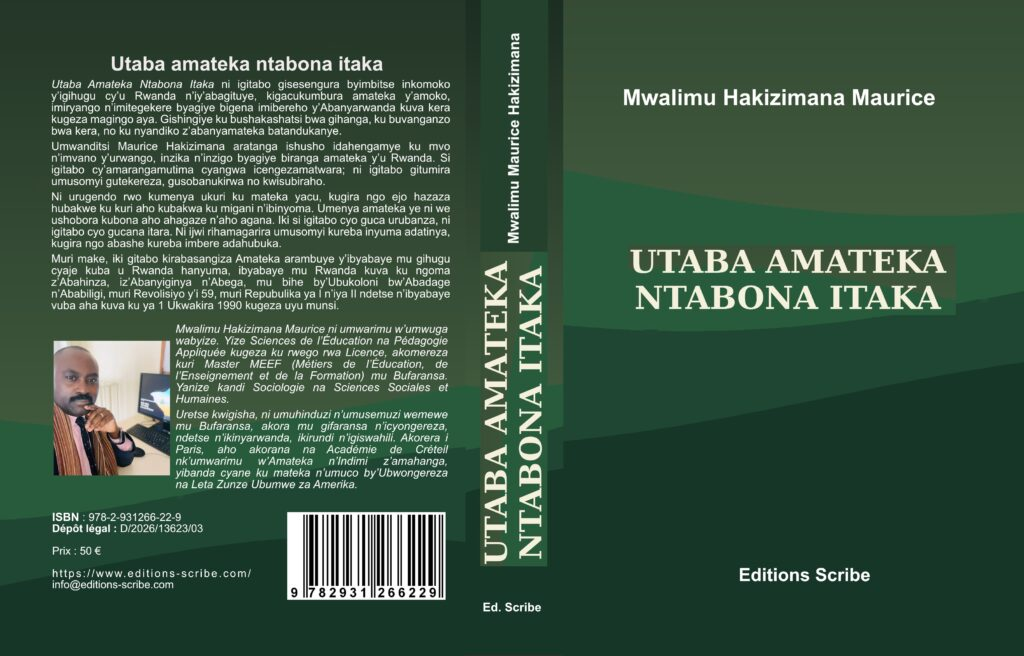
Professor Hakizimana Maurice is the author of the book “UTABA AMATEKA NTABONA ITAKA” (Editions Scribes).
PUB
TIDAS – Translation, Interpreting & Support for Your Asylum and Residency Procedures in France
Welcome to TIDAS (Translation, Interpreting, and Asylum & Residency Assistance in France).Our mission: to help foreigners in France overcome language barriers and administrative obstacles.
Our services:
Translation and interpreting for your appointments and documents
Support with asylum applications
Assistance with all your administrative procedures
With TIDAS, you benefit from a professional, caring, and reliable service.We believe that everyone deserves to be understood and supported.
Contact us today and let’s move forward together at (+33) 07 58 90 35 49 or email us at tidasetvous@gmail.com
TIDAS :
- “TIDAS – Always by Your Side”
- “The Voice of Foreigners in France”
- “Understand, Translate, Support”