Prof HAKIZIMANA Maurice
The second instalment in our exploration of the language of love in Rwanda. After the world of cattle, the water lily, taro water, the white egret and even the sun become sources of imagery through which poets and singers celebrate feminine beauty.
IIFollow us on WhatsAppIIWhatsapp https://whatsapp.com/channel/0029VaCyM5ILdQejDYwQ2b2u — Follow us on Facebook!.https://www.facebook.com/professormaurice/.
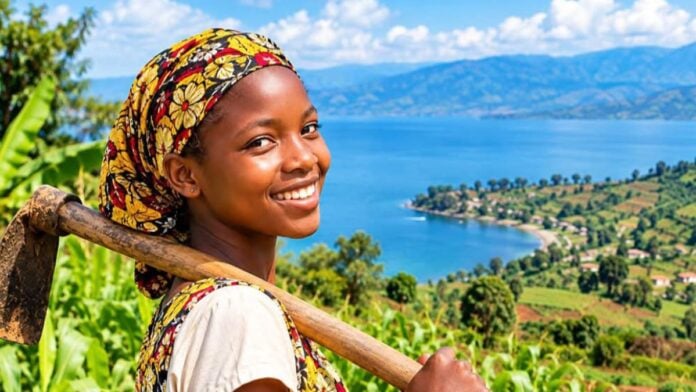
Beauty Inspired by Nature
(1) The Special Place of the Water Lily (Irebe)
In the Rwandan aesthetic imagination, the water lily (irebe) holds a special place in the poetic portrayal of feminine beauty, as I briefly mentioned in the previous section through an excerpt from the work of Cyprien Rugamba.
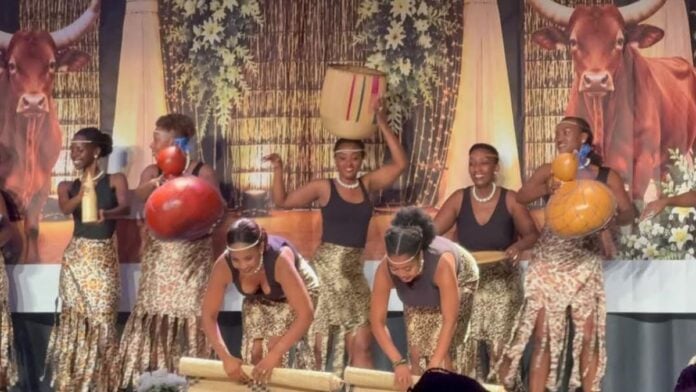
Rwanda traditional women
In Rwandan modern poetry, flowers more broadly constitute privileged poetic motifs for evoking beauty and expressing romantic feelings. Their presence contrasts with traditional representations of feminine beauty that predate European influence. Indeed, the body of material available from that earlier period reveals no symbolic references to flowers in the Rwandan aesthetic imagination.
The excerpt from the song Ururabo (“The Flower”), performed by the Nyampinga Orchestra, precisely associates the image of a flower with that of the water lily (irebe):
Rurabo nateye ahatava izuba — Flower I planted in a place sheltered from the sun,
Mu cyi ntirwuma, rurahehera — During the dry season, instead of withering, it grows even denser.
Rebe nateye mu mutima wanjye — Water lily planted in my heart,
Nta wundi uteze kuwicaraho — No one else shall ever take its place…
(2) The Figurative Expression Maziyateke (Taro Water)
In the Rwandan aesthetic imagination, the name Maziyateke constitutes a distinctive poetic image of feminine beauty, whose full symbolic richness is difficult to convey in another language. Literally, the expression means “taro water” and evokes the water that beads or trickles across the surface of this plant’s leaves. Through its clarity and transparency, this water is associated with a pure, delicate and luminous beauty.
Beyond its literal meaning, this image, imbued with a sensibility deeply rooted in Rwandan culture, has inspired poets and singers across different generations, who have found in it a subtle way of celebrating feminine beauty. Some singers, however, exercise a degree of poetic freedom by adapting the expression into isoko ku iteke (“a spring of water on the taro”).
Excerpt from the play Maziyateke ndagiye (“Taro Water, I Am Leaving”) by Byuma François Xavier:
Maziyateke — Taro water.
Ariko umenya ndi ihoho — There is no doubt that I am exceptionally beautiful!
Reka mpogoze abasore benshi — Let me make many young men lose their hearts!
Bahora bandangamiye bifuza kunsaba — They never tire of gazing at me, each dreaming of asking for my hand in marriage…
Excerpt from the song by Soso Mado, performed by the Impala Orchestra of Kigali:
Soko ku iteke — A spring on the taro.
Mbe soko ku iteke — Oh, spring on the taro!
Ukundwa na bose — You, whom everyone cherishes,
Ko nanjye numva ngukunda — I, too, feel that I am in love with you…
(3) Birds: Grace, Elegance and Distinction
Among the birds with which the Rwandan aesthetic imagination associates feminine beauty, inyange (the white egret) occupies a particularly important place. Indeed, this bird serves as a significant symbolic reference in the representation of feminine beauty. Its presence among cattle herds also contributes to strengthening its symbolic value in the Rwandan imagination.
In Cyprien Rugamba’s poem, Nugururiye inyange (“I Opened the Gate for the White Egret”), the choice of the verb nugururiye, rather than nakinguriye, deserves particular attention. Although both verbs convey the idea of opening, the former is notably used to describe the act of opening a gate to let cattle out, whereas the latter is more commonly associated with opening a door to welcome a person. This lexical choice therefore takes on particular significance in a poem in which the female figure is evoked through the image of the white egret.
Nugururiye inyange (“I Opened the Gate for the White Egret”):
Musaninyange aza kunsura — When the maiden embodied as a white egret came to visit me,
Yaje wese yisukuye — She arrived, radiant with purity from head to toe,
Urusogo rw’umuteto w’ubuto — Like a tender bud of youth,
Rukimutemba amatama yombi — Whose freshness seemed to flow across both her cheeks…
Another example of the symbolic representation of this bird appears in the song Wintatira (“Don’t Disappoint Me”), performed by the Nyampinga Orchestra in the 1980s:
Mbe kanyange karembera kure — Oh, little white egret soaring far away from me…
Ko unsize, kuki umpunze ? — Now that you have left me, why are you running away?
Habaye iki ? — What has happened?
Ese mukundwa, mbaye uwande ? — Oh, my beloved, what is to become of me?
(4) The Sun: A Symbol of the Radiance and Brilliance of Feminine Beauty
Celestial bodies, and the Sun in particular, serve as symbolic references in the representation of feminine beauty. Through their brilliance, luminosity and radiance, they evoke a beauty that illuminates, shines and stands out. The Sun thus embodies an image of dazzling, radiant beauty, whose splendour attracts the eye and inspires admiration.
This association between the Sun and feminine beauty is notably expressed in the song Wowe Zuba (“Oh, You, Sun”) by Sebanani André. Here is an excerpt:
Wowe Zuba — Oh, you, Sun,
Zuba ryanjye — My Sun,
Rirasira iburasirazuba — You who rise in the East,
Ohereza imirasire yawe… — Send me your rays…
The same solar imagery appears in the song Ibanga rizwi na bake (“A Secret Known to Few”), by Gasasira Jean-Félix, popularly known as Soso Mado. Here is an excerpt:
Nkunda inseko yawe we — I love your smile,
Nkunda ukuntu unyitaho — I love the way you care for me,
Uri akazuba ko mu museso — You are the gentle morning sun.
These two songs illustrate how the image of the Sun is used to evoke feminine beauty, tenderness and powers of seduction. It is also worth recalling that both singers were members of the famous Impala Orchestra of Kigali, which enjoyed considerable popularity in the 1980s.
(5) Kiberinka: An Interweaving of Symbolic Images
For the readers’ enjoyment, I would also like to mention another combination of symbolic images, embodied in the name Kiberinka, traditionally given to young girls.
This name carries a particularly evocative double meaning. On the one hand, it refers to a young woman who deserves to receive a cow as bridewealth, on account of her beauty and qualities. On the other hand, it evokes the setting sun, the time of day when cattle are traditionally taken out to graze. This polysemy thus establishes a poetic connection between feminine beauty, the symbolic value of cattle and the fading light of the setting sun.
This semantic richness is particularly evident in the following lyrics from Kiberinka (“Sunset”):
Yewe Kiberinka uri umwari — Oh, Kiberinka, you are a truly accomplished young woman!
Yewe Kiberinka uri umutoni — Oh, Kiberinka, you are the cherished favourite!
Yewe Kiberinka, uri nyampinga — Oh, Kiberinka, you are a true weaver of bonds!
Conclusion
Rwandan words are deeply imbued with symbols associated with beauty and love, as we have sought to demonstrate in the first and second parts of this exploration. This work, however, represents only a glimpse into a remarkably rich sociolinguistic and cultural heritage, one that deserves further exploration and greater public recognition.
Over the decades, Rwandan music has undergone transformations reflected not only in its musical forms but also in the ways feminine beauty is portrayed and celebrated. Whereas traditional expressions often favoured references to nature, animals and landscape features, contemporary productions introduce other images and new forms of expression. These developments bear witness to changing sensibilities and aesthetic perceptions within Rwandan society.
The contemporary song Mariya Jeanne, performed by Nsengiyumva, provides an illustration of this evolution through lyrics that employ distinctive images and expressions to evoke feminine beauty.
Excerpt from Mariya Jeanne by Nsengiyumva:
Amatako ye zose ni amatamati — “Her thighs are like ripe tomatoes.”
Intege ze zose ngo zitemba amaribori — “Fine, delicate lines seem to ripple along her calves.”
Ni igisupusupu, ni igisukari majyane — “She is a rich, creamy soup, infused with an intense sweetness…”
Oh mama Mariya weee — “Oh, sweet Maria!”
Through these images, the song offers a glimpse of renewed ways of representing feminine beauty. It also illustrates the evolution of language in modern Rwandan music, which is characterised by a genuine symbiosis between linguistic borrowings and urban vernaculars. It thus demonstrates how linguistic and musical transformations go hand in hand with the evolution of aesthetic perceptions.
Sources: Article originally written in french by Faustin Kabanza for Afrik.com.Translated and published in english by Maurice Hakizimana.

About the Author
Mwalimu Hakizimana Maurice is a teacher, interpreter-translator and writer based in Paris, France. He is the founder and owner of the information and educational platform Eurêka Academy Studio, also available on YouTube under the name Eurêka Studio TV.
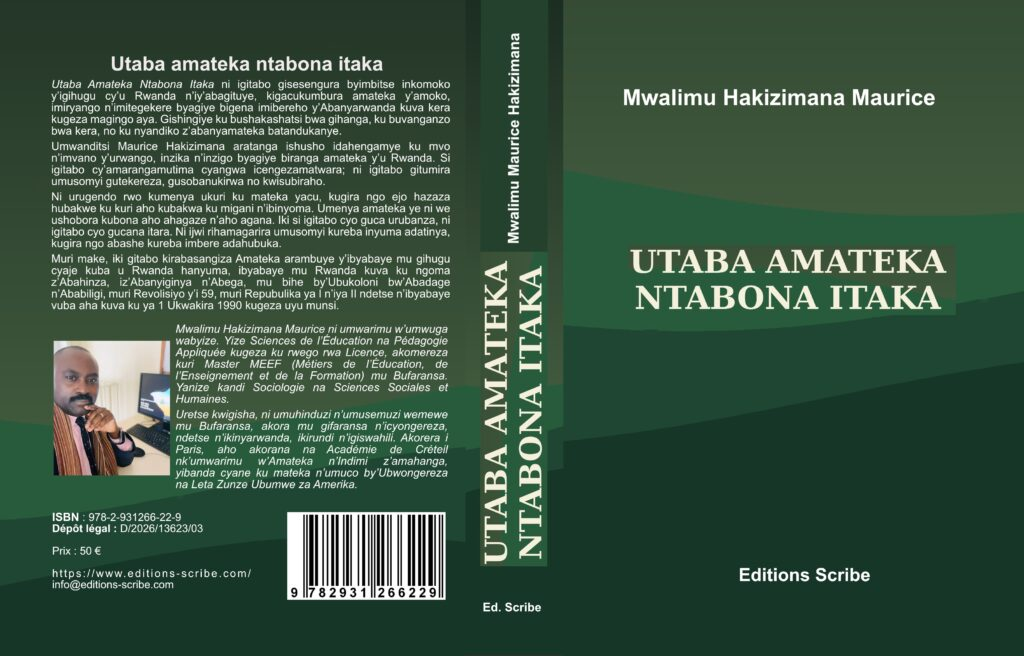
Professor Hakizimana Maurice is the author of the book “UTABA AMATEKA NTABONA ITAKA” (Editions Scribes).
Don’t miss any of the latest publications and updates from Eurêka Academy Studio, available here on our website and on YouTube through Eurêka Studio TV.
PUB
TIDAS – Translation, Interpreting & Support for Your Asylum and Residency Procedures in France
Welcome to TIDAS (Translation, Interpreting, and Asylum & Residency Assistance in France).Our mission: to help foreigners in France overcome language barriers and administrative obstacles.
Our services:
Translation and interpreting for your appointments and documents
Support with asylum applications
Assistance with all your administrative procedures
With TIDAS, you benefit from a professional, caring, and reliable service.We believe that everyone deserves to be understood and supported.
Contact us today and let’s move forward together at (+33) 07 58 90 35 49 or email us at tidasetvous@gmail.com
TIDAS :
- “TIDAS – Always by Your Side”
- “The Voice of Foreigners in France”
- “Understand, Translate, Support”