In Rwandan culture, particularly in songs, traditional poetry, and the language of love in Kinyarwanda, feminine beauty occupies a unique place. It is not limited to physical appearance: it is narrated, sung about, and suggested through images drawn from nature, the animal kingdom, and the plant world.
The eyes, face, gait, figure, gentleness, and charm all serve as sources of inspiration for a figurative language in which words transcend their ordinary meanings to express admiration, tenderness, and romantic affection.
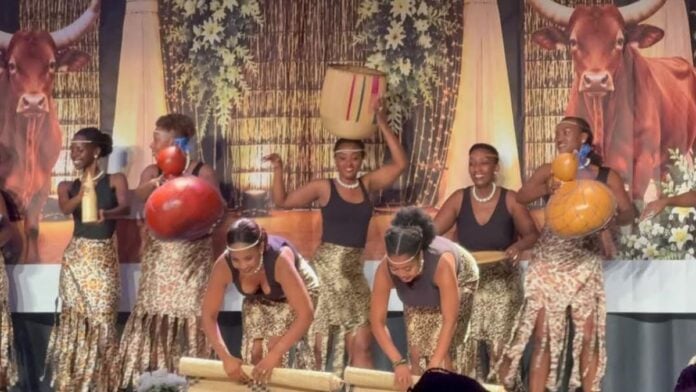
In Rwandan society, the cow holds a particularly important place, especially in the pastoral imagination. Depending on the context, it is associated with wealth, prestige, nobility, and elegance. It has also played a significant role in social and matrimonial relationships, particularly in traditional practices involving the bride price.
Beyond its economic value, the cow has profoundly shaped Rwanda’s collective imagination and cultural heritage. Its symbolic importance is also reflected in the language of love, where the cow, the calf, and certain images associated with cattle are used to evoke feminine beauty.
Pastoral vocabulary thus becomes a source of poetic imagery through which admiration, tenderness, and a woman’s charm can be expressed indirectly and suggestively.
(2) The Little Calf (Akanyana)
The wordakanyanais a diminutive of inyana, meaning “calf.” When used in the language of love, it can refer to a beloved young woman and evoke the beauty of youth, tenderness, and emotional attachment.
This imagery can be found in feminine names such as Kanyana andMunyana, as well as in Rwandan song lyrics, where references to pastoral life help express admiration and romantic feelings.
The expression “Iyizire, kanyana kanjye“—”Come, my little calf”—illustrates this figurative use of language in Rwandan culture.
The calf is no longer simply a young animal. It becomes an affectionate, poetic name through which a lover addresses his beloved.
(3) The Calf’s Eyes (Amaso y’Inyana)
Literally,amaso y’inyanameans “the calf’s eyes.” In the language of love, this image can evoke a gentle, expressive, and captivating gaze, depending on the poetic context.
The eyes thus become a mirror of tenderness and emotion, helping to convey the beauty of a woman’s face.
An excerpt from the song Umutesi, performed by the group Les Amis des Jeunes, illustrates this poetic tradition:
“Uri umutesi“ — “You are a princess.” “Umutesi wanjye, maso y’inyana“ — “My princess, with the eyes of a calf.” “Mwana wampogoje” — “Young woman, you have swept me off my feet.”
Through these affectionate expressions, the singer celebrates the beloved’s beauty while conveying the emotional power he holds over her.
Song:Uri Umutesi — Orchestre Les Amis des Jeunes.
(4) The Calf’s Bedding (Akarire k’Inyana)
This image is also used in poetic expressions of love. Literally, akarire k’inyana refers to the bedding on which a calf rests, providing it with a place of comfort and repose.
In the context of poetry and song, the image can be interpreted as an evocation of softness, delicacy, and the welcoming nature associated with this natural setting.
An excerpt from Selemani Gasirabo’s song Karire k’Inyana illustrates this imagery:
“Karire k’inyana, mubiri utemba itoto” — “O soft bedding of the calf, a body overflowing with freshness and youthful vitality.” “Wowe bwiza budashira irora” — “O you, beauty that never ceases to delight the eyes.” “Agaseke karapfundikiye” — “The little basket remains covered.” “Nzagapfundura ari uko uje” — “I shall uncover it only when you come.”
The imagery combines beauty, freshness, mystery, and anticipation. The covered basket, in particular, introduces a sense of intimacy and expectation, leaving room for poetic interpretation.
Song:Karire k’Inyana — Selemani Gasirabo, with lyrics.
(5) Beauty Reflected in Cattle Coat Colours
The colours of cattle coats also serve as symbolic references to feminine beauty.
For example, the colour igaju, referring to a light-brown coat, has inspired feminine names such as Gaju and Mukabyagaju, the latter referring to a darker shade.
The colour isine describes a dark-brown coat marked with lighter brown nuances. This reference is reflected in the feminine name Mukasine. In this context, the prefix muka expresses an association with the cow known as isine.
These names reveal how closely the natural world and pastoral traditions are intertwined with Rwanda’s cultural imagination.
The different shades of cattle coats thus bear witness to the privileged place occupied by the cow in traditional Rwandan perceptions of beauty and aesthetics.
(6) Feminine Beauty and Its Celebration Through the Bride Price
In traditional Rwandan culture, feminine beauty is symbolically associated with marriage and the bride price. This representation can be found in certain names given to girls at birth.
For example, the nameMurorunkwere conveys the idea: “At the mere sight of my daughter, you will be overcome with the desire to offer me a bride price.“
This name expresses a father’s pride in his daughter’s beauty and illustrates the symbolic connection between feminine charm, marriage, and the bride price in Rwandan tradition.
It reflects a cultural imagination in which beauty is celebrated not merely as a physical attribute but also as a source of admiration and a subject of poetic expression.
Beauty Associated with Traditional Objects Worn or Carried by Women
(7) The Young Women’s Walking Stick (Gakoni k’Abakobwa)
In traditional Rwanda, young women could carry small walking sticks when travelling on foot or when tending calves.
Beyond their practical function, these sticks also acquired symbolic associations with feminine beauty. The expression gakoni k’abakobwa (“the young women’s walking stick“) thus evokes the beauty and elegance of young women in a poetic manner.
An excerpt from a song by Mavenge Sudi illustrates this imagery:
“Gakoni k’abakobwa“ — “Walking stick of the young women.” “Iribagiza, uri umwana w’ingenzi” — “You, the dazzling one, are a precious young woman.” “Tambuka uze neza” — “Walk gracefully and come beautifully.”
The walking stick becomes more than an everyday object. Through the poetic imagination, it becomes associated with feminine grace, distinction, and elegance.
Song:Gakoni k’Abakobwa — Mavenge Sudi, original version.
The Human Body: Beauty in the Details
(8) Beauty Striations (Amaribori)
In Rwandan poetry, amariborirepresents an image associated with feminine beauty. This imagery appears notably in the poem by Cyprien Rugamba, entitled Marebe Atembaho Amaribori.
The opening lines can be translated as follows:
“Marebe atembaho amaribori“ — “Water lily adorned with beautiful striations.“ “Naramubonye agorora ikimero” — “I saw her unfold the full splendour of her graceful figure.”
The water lily becomes a poetic image through which the beauty of a woman is celebrated. The reference to amaribori suggests distinctive markings or lines that enhance the flower’s appearance, creating a metaphor for the details that contribute to a woman’s elegance.
Rather than describing beauty in general terms, the poet draws attention to its individual features, revealing how small details can contribute to the harmony and splendour of the whole.
Song:Marebe Atembaho Amaribori — performed by Cécile Kayirebwa; cover by Muragijimana Pascaline.
(9) The Charming Gap Between the Front Teeth (Menyo y’Inyinya)
The charm of a diastema, the gap between the two upper front teeth, is recognised and appreciated in traditional representations of feminine beauty in Rwanda.
Associated with a smile, it contributes to the expression of a natural and distinctive beauty. Rather than being regarded simply as a physical characteristic, it can become an appealing feature worthy of admiration and poetic celebration.
An excerpt from a song by the Virtose group offers a striking illustration:
“Simbi we (…)” — “O Snow White!” “Nsekera shenge, mbone inyinya“ — “Smile at me, my dear, so I can admire the charming gap between your front teeth.“ “Ndebe amenyo y’inono” — “Let me admire your beautifully speckled white teeth.” “Utatse ubwiza bwaka de” — “You are adorned with beauty, radiant and shining.” “Wariboye uko ureshya” — “Adorned with beautiful striations befitting your stature and grace.”
These expressions reveal a poetic sensibility that celebrates the smallest details of a woman’s appearance. Her smile, teeth, and distinctive features become sources of fascination and affection.
The beloved is not praised merely for possessing beauty; she is celebrated for the particular qualities that make her unique.
Song:Ngeri Ibasumba — a cover version of a much-loved song.
(10) Conclusion
This first part has highlighted the distinctive place occupied by the cow in the Rwandan imagination of feminine beauty.Through images drawn from cattle, pastoral life, traditional objects, and the human body, we have explored how the Kinyarwanda language of love transforms familiar elements of everyday life into poetic expressions of admiration and tenderness.
In this cultural tradition, beauty is not simply described: it is suggested through images, evoked through metaphors, and celebrated through words whose meaning often extends beyond their literal interpretation.
The richness of this language reveals a poetic heritage in which nature, social customs, and human emotions are closely intertwined.
In the second part, we shall broaden our exploration to other sources of inspiration in the language of love, examining how nature, birds, and stars also nourish the poetry of words and the celebration of feminine beauty.
TIDAS – Translation, Interpreting & Support for Your Asylum and Residency Procedures in France
Welcome to TIDAS (Translation, Interpreting, and Asylum & Residency Assistance in France).Our mission: to help foreigners in France overcome language barriers and administrative obstacles.
Our services:
Translation and interpreting for your appointments and documents
Support with asylum applications
Assistance with all your administrative procedures
With TIDAS, you benefit from a professional, caring, and reliable service.We believe that everyone deserves to be understood and supported.
Contact us today and let’s move forward together at (+33) 07 58 90 35 49 or email us at tidasetvous@gmail.com
TIDAS :
“TIDAS – Always by Your Side”
“The Voice of Foreigners in France”
“Understand, Translate, Support”
4 thoughts on “When Words Whisper to the Heart: The Poetry of Rwandan Love”


zeiniez.fashion
For the reason that the admin of this site is working, no uncertainty very quickly it will be renowned, due to its quality contents.
very informative articles or reviews at this time.
Hi there to all, for the reason that I am genuinely keen of reading this website’s post to be updated on a regular basis. It carries pleasant stuff.