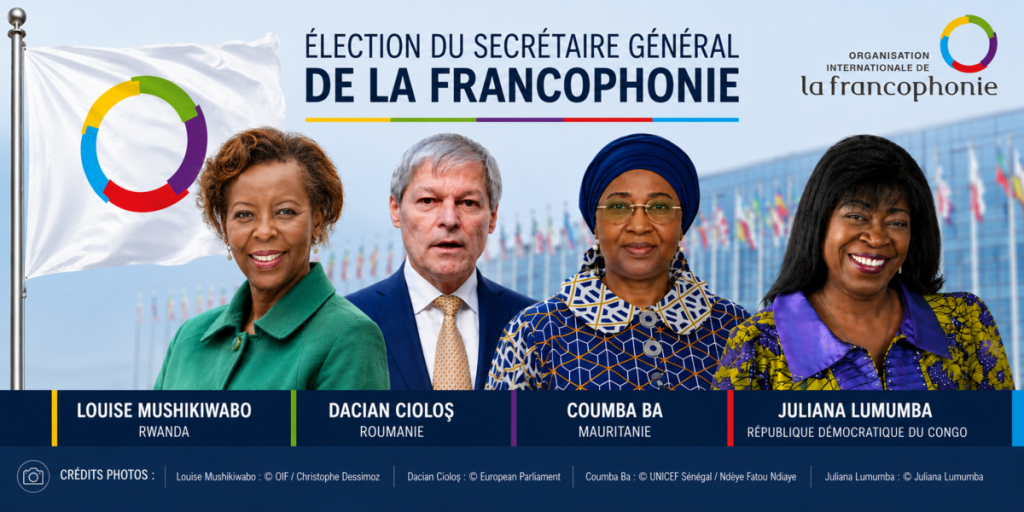
On the eve of the election of the next Secretary-General of the International Organisation of La Francophonie (OIF), I do not wish to fuel a debate that has already attracted considerable attention and, at times, strong emotions. The candidates, their ambitions and the issues surrounding this election understandably occupy people’s minds. Yet beyond individuals and circumstances, a more fundamental question deserves our attention: what future lies ahead for La Francophonie, and, above all, what place should be given to its human dimension?
Words can help heal wounds only when they move beyond promises and are translated into concrete commitments and action. This requires renewing La Francophonie’s political and ethical framework, learning from the past without becoming trapped by it, in order to build a more humane Francophonie.
In my view, five concepts could serve as the new pillars of this vision of La Francophonie: dignity, uniqueness, reciprocity, justice and boldness.

1. Dignity: The Foundation of a Truly Humane Francophonie
Dignity is the cornerstone of any genuinely humane Francophonie of the future. A renewed Francophonie must unequivocally condemn, wherever they occur and whoever their perpetrators may be, violations of fundamental rights, violence, discrimination and humiliation that undermine human dignity.
Similar article: France–Africa: If I Were the Next President of the Republic…
It cannot turn a blind eye in the name of alliances, political interests or diplomatic considerations. The defence of human dignity cannot be selective, and no human suffering should ever be relegated to the background.
In the face of today’s global transformations, remaining silent in the face of the unacceptable must not be mistaken for diplomatic prudence. La Francophonie must now move its values from declarations to action. Human dignity is not something to be proclaimed; it must be respected, protected and defended.
Today’s world, and even more so the world taking shape before us, bears little resemblance to the world of yesterday. Information now travels instantaneously, while events are documented, shared and discussed worldwide. Social media, artificial intelligence and new digital technologies make realities increasingly visible, but they also expose the silences, contradictions and inconsistencies in institutional discourse. In such a context, turning a blind eye cannot preserve an institution’s credibility; on the contrary, it may undermine it even more than an acknowledged and openly assumed mistake.
This commitment also requires La Francophonie to take an honest look at its own practices, question its silences and account for its positions. It must also listen more attentively to civil society and independent voices, so that the defence of fundamental rights remains a constant requirement rather than a variable adjusted to diplomatic convenience.
2. Uniqueness: Recognising and Protecting Identities and Differences
A renewed Francophonie must certainly take into account the realities shared by its members, but it must also pay particular attention to their individual characteristics and specific circumstances. This could even become one of its defining features: the ability to recognise, respect and defend differences, vulnerabilities and particular realities that are often overlooked by strategic considerations or political agendas.
Languages, cultures, customs and expressions of identity, as well as the vulnerabilities of individuals and communities that are less visible, more isolated or more marginalised, must be better identified, recognised and valued.
For La Francophonie must not confuse unity with uniformity, nor reduce diversity to a mere folkloric celebration of differences. On the contrary, it must make diversity a genuine political, cultural and human asset by giving meaningful space to minority identities, less widely represented languages and cultural expressions that struggle to gain recognition.
The issue is not simply to tolerate differences, but to acknowledge their legitimacy and provide them with the means to exist and flourish.
Recognising these distinctive characteristics also requires genuine independence of judgement. La Francophonie must avoid uncritically adopting dominant narratives without subjecting them to critical scrutiny. It must be capable of stepping back, examining claims against the facts and distinguishing truth from falsehood, rather than being swept along by narratives imposed without sufficient evidence.
Respecting diversity also means accepting a plurality of viewpoints and refusing to elevate one particular interpretation of the world into a universal truth.
It is precisely through this ability to build unity without erasing individual identities and differences that the OIF could assert its own distinctive identity and turn diversity from a mere principle of celebration into a genuine foundation for its actions.
READ also: Francophonie: Is It on the Brink of Fragmentation?
3. Reciprocity: The Need for Balanced Relations Between Peoples and States
A truly humane Francophonie must be a space for sharing and exchanging knowledge, experiences, cultures and resources, in which every people and every State contributes what it is and what it possesses, while remaining willing to welcome what others have to offer.
The richness of these exchanges should be measured neither by their volume nor by the power of those who make them possible, but by the value attributed to each contribution. The aim is not to demand that everyone give the same things, but to ensure that every contribution, whatever its nature, receives equal consideration.
This principle requires moving beyond relationships based on dependency, domination or condescension. No people should be reduced to the status of a mere recipient of other people’s solidarity, just as no State should claim a monopoly on making contributions. Everyone must be able both to give and to receive, within a dynamic of mutual recognition.
Reciprocity does not require equality of resources or means, but rather balance in recognition and consideration. Differences in capacity among Francophone partners should therefore not become pretexts for establishing hierarchical relationships, but opportunities for complementarity and mutual enrichment.
According to anthropologist Marcel Mauss, societies progress insofar as they, their constituent groups and, ultimately, their individuals are able to establish stable relationships based on three principles: giving, receiving and reciprocating. This reflection invites us to view exchanges within the Francophone community not merely as transfers of resources, but as human relationships founded on sharing, trust and mutual recognition.
The Francophonie of tomorrow will only be truly united in solidarity if each member is recognised not only for what it receives, but also for what it contributes to the Francophone community. It is through this mutual recognition, made possible in particular by the shared use of the French language, that a genuine culture of reciprocity can take shape.
READ also :The Rwandan Army’s team has been excluded from the Basketball Africa League (BAL) because of sanctions imposed on the Rwandan military.
4. Justice: Giving Concrete Expression to Equality and Equity
Justice is certainly not a new concept in the vocabulary of La Francophonie. It has long been among the values and principles to which the institution subscribes. However, its presence in official discourse does not necessarily guarantee its application in practice. It therefore deserves to be reaffirmed, not merely as a declared value, but as a requirement that must guide decisions, policies and relations among member states.
In this respect, justice is the natural extension of the principles discussed above. Dignity requires that every people be treated with equal respect; uniqueness calls for its differences to be recognised; and reciprocity implies that its contribution be valued fairly. Justice must ensure that these principles are effectively reflected in institutional relations and in the distribution of opportunities, responsibilities and resources.
A more humane Francophonie cannot therefore be satisfied with proclaimed equality alone; it must make equity a tangible reality. Only then will justice cease to be a principle merely invoked and become a principle put into practice.
5. Boldness: The Will to Transform La Francophonie and Give It New Momentum
La Francophonie cannot renew itself simply by reproducing past practices or preserving arrangements that no longer fully reflect the realities of the contemporary world. It must have the courage to question itself, embrace the changes that are necessary and explore new paths, even if this means challenging certain established habits and breaking away from conventional approaches.
Boldness, however, does not mean systematically breaking with the past, nor does it mean pursuing change for its own sake. Rather, it consists in building on past achievements to push their boundaries further, honestly acknowledging the institution’s shortcomings and undertaking the changes that circumstances demand.
La Francophonie’s age and experience should be sources of confidence rather than reasons to fear change. An African proverb reminds us that “when the roots are deep enough, there is no reason to fear the wind.”
The Francophonie of tomorrow must now have the boldness to surprise its time and help shape the world that is emerging. Its next Secretary-General must know how to turn this legacy into a springboard rather than a refuge, a source of momentum rather than an anchor.
Bibliographical reference
Mauss, Marcel (1925). The Gift: Forms and Functions of Exchange in Archaic Societies. Originally published in L’Année sociologique, new series, Volume I, 1923–1924.

Article originally written in french by Faustin Kabanza.Translated and published in english by Maurice Hakizimana.

About the Author
Mwalimu Hakizimana Maurice is a teacher, interpreter-translator and writer based in Paris, France. He is the founder and owner of the information and educational platform Eurêka Academy Studio, also available on YouTube under the name Eurêka Studio TV.
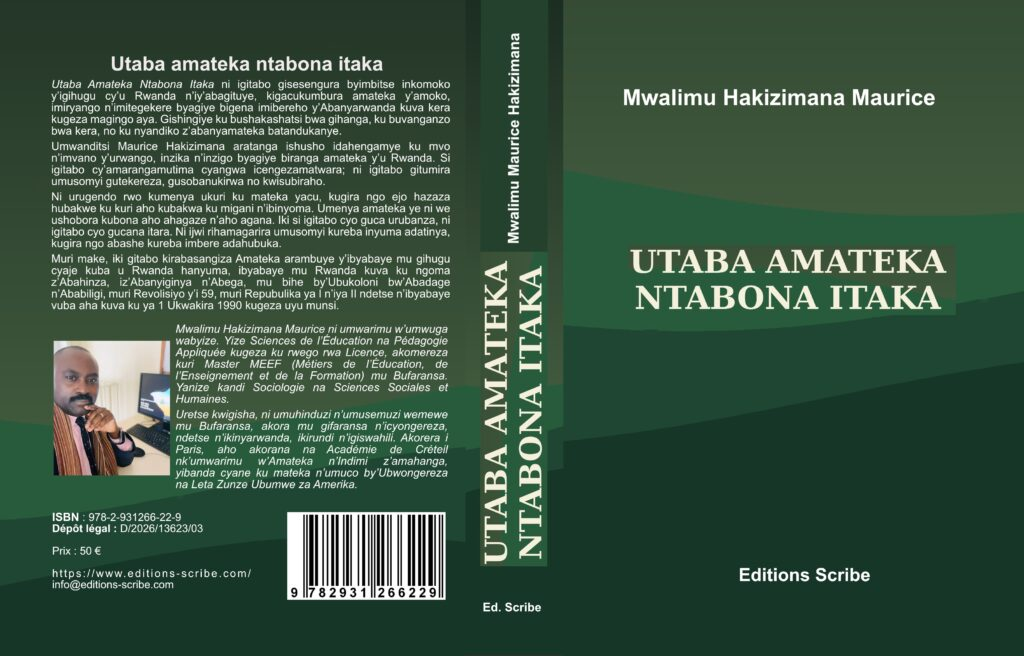
Professor Hakizimana Maurice is the author of the book “UTABA AMATEKA NTABONA ITAKA” (Editions Scribes).
Don’t miss any of the latest publications and updates from Eurêka Academy Studio, available here on our website and on YouTube through Eurêka Studio TV.
PUB
TIDAS – Translation, Interpreting & Support for Your Asylum and Residency Procedures in France
Welcome to TIDAS (Translation, Interpreting, and Asylum & Residency Assistance in France).Our mission: to help foreigners in France overcome language barriers and administrative obstacles.
Our services:
Translation and interpreting for your appointments and documents
Support with asylum applications
Assistance with all your administrative procedures
With TIDAS, you benefit from a professional, caring, and reliable service.We believe that everyone deserves to be understood and supported.
Contact us today and let’s move forward together at (+33) 07 58 90 35 49 or email us at tidasetvous@gmail.com
TIDAS :
- “TIDAS – Always by Your Side”
- “The Voice of Foreigners in France”
- “Understand, Translate, Support”