By prof HAKIZIMANA Maurice
Cheikh Hamidou Kane: There are men whose passing does not silence their voice. Their legacy endures, like words entrusted to time, destined to cross generations.
With the passing of Cheikh Hamidou Kane, who died on October 3, 2026, in Dakar, at the age of 98, a major voice of African literature and thought has fallen silent. Yet beyond the silence left by this remarkable man, there remains a body of work that continues to travel, crossing borders, cities, and villages.
Follow us on WhatsApp — [WhatsApp] — and also follow us on Facebook.
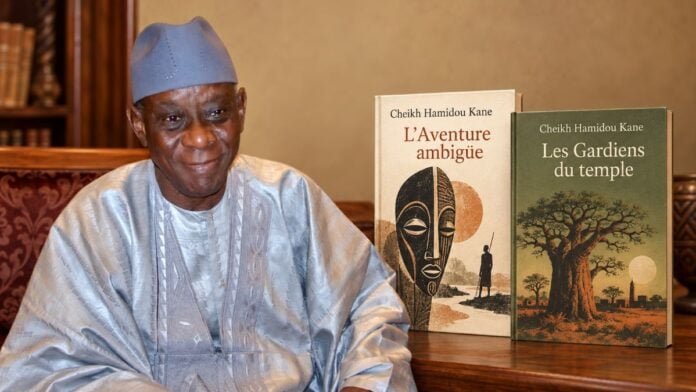
Today, ambiguity itself seems to have found a form of resolution. The movement between two worlds, the openness to others, and the search for oneself that ran through his work take on a new resonance with his passing. After the adventure comes destiny: the destiny of a man who crossed several worlds while constantly seeking ways to connect them, to welcome the other without renouncing oneself.
From Literature to the Man
Behind the writer stood a man whose life journey, in its own way, extended the questions explored in his work. Educated in the Islamic tradition and in Qur’anic teaching, and later in the French educational system, Cheikh Hamidou Kane pursued studies in law and philosophy in France.
Upon returning to Senegal, he devoted a large part of his life to public service. A senior civil servant, governor of Thiès in the aftermath of independence, and later a minister, he also held international responsibilities. His journey between different worlds thus nourished a reflection that he would eventually transpose into his literary work.
Published in 1961, L’Aventure ambiguë became one of the great works of African literature. Through Samba Diallo, Cheikh Hamidou Kane portrayed the inner conflict of a man caught between two worlds, two forms of knowledge, and two ways of inhabiting the world. In 1962, the novel earned him the Grand Prix littéraire d’Afrique noire.
Samba Diallo, the embodiment of the tension between tradition and modernity in L’Aventure ambiguë, finds an echo more than thirty years later in Les Gardiens du temple, through Salif Bâ, an agricultural engineer more inclined toward action and engagement. Two different figures in the way they confront the world, yet ultimately carrying the same question: How can one encounter the other without losing oneself?
Senegalese President Bassirou Diomaye Faye also highlighted this dimension of Kane’s work, observing that through L’Aventure ambiguë, Cheikh Hamidou Kane had given generations of Africans “the words to think about a question that still lives within us”: how to “open ourselves to the knowledge of the world without losing anything of who we are.”
These words also resonate with the memories of those who discovered and studied his work far from Senegal. For my part, I will remember the pages of L’Aventure ambiguë that I studied with passion at the Faculty of Arts in Rwanda, around the turn of the 2000s.
The Word Endures
Born on April 2, 1928, in Matam, northern Senegal, Cheikh Hamidou Kane lived through nearly a century of African history. With only two novels, he established himself as one of the great African writers in the French language, while L’Aventure ambiguë became a classic studied far beyond Senegal.
Death closes a life, but it does not necessarily close a work. His work will continue in classrooms, universities, libraries, and in the memories of those who, like me, encountered Samba Diallo one day through a lesson, a reading, or a reflection on our own relationship with the world.
The final page has been turned; the book, however, remains open…
Farewell to the author of L’Aventure ambiguë.
Source:Faustin Kabanza
Source: Afrik.com — Article originally written in french by Faustin Kabanza, a committed thinker and columnist particularly attentive to sociopolitical, intellectual, and human issues related to Africa, especially Central Africa. A linguist and specialized educator by training, he is interested in the transmission of knowledge and the continent’s cultural and social dynamics.
This World

Mwalimu Hakizimana Maurice is a teacher, a translator-interpreter, and a writer based in Paris, France.
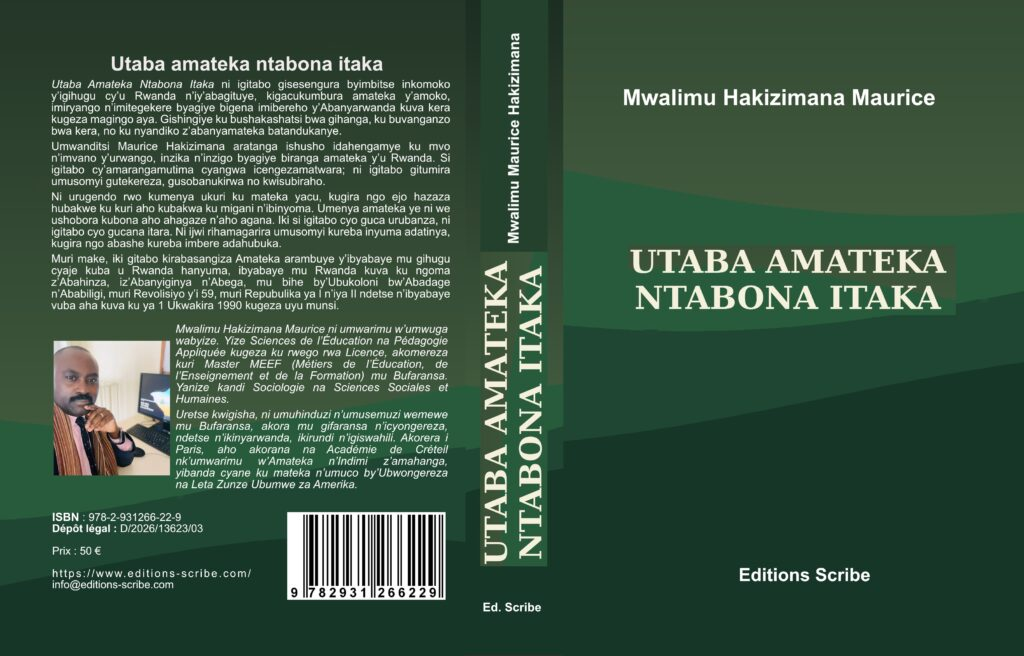
Professor Hakizimana Maurice is the author of the book “UTABA AMATEKA NTABONA ITAKA” (Editions Scribes).
PUB
TIDAS – Translation, Interpreting & Support for Your Asylum and Residency Procedures in France
Welcome to TIDAS (Translation, Interpreting, and Asylum & Residency Assistance in France).Our mission: to help foreigners in France overcome language barriers and administrative obstacles.
Our services:
Translation and interpreting for your appointments and documents
Support with asylum applications
Assistance with all your administrative procedures
With TIDAS, you benefit from a professional, caring, and reliable service.We believe that everyone deserves to be understood and supported.
Contact us today and let’s move forward together at (+33) 07 58 90 35 49 or email us at tidasetvous@gmail.com
TIDAS :
- “TIDAS – Always by Your Side”
- “The Voice of Foreigners in France”
- “Understand, Translate, Support”