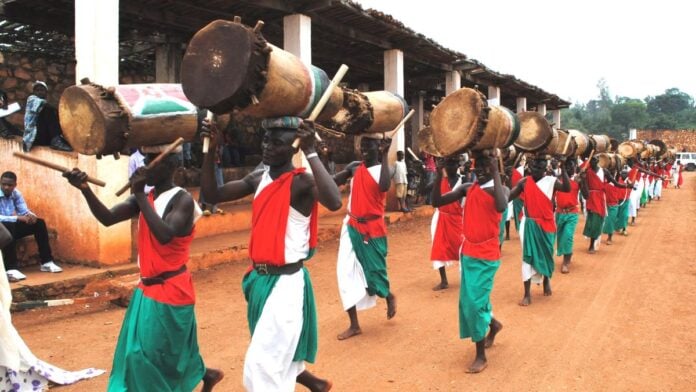
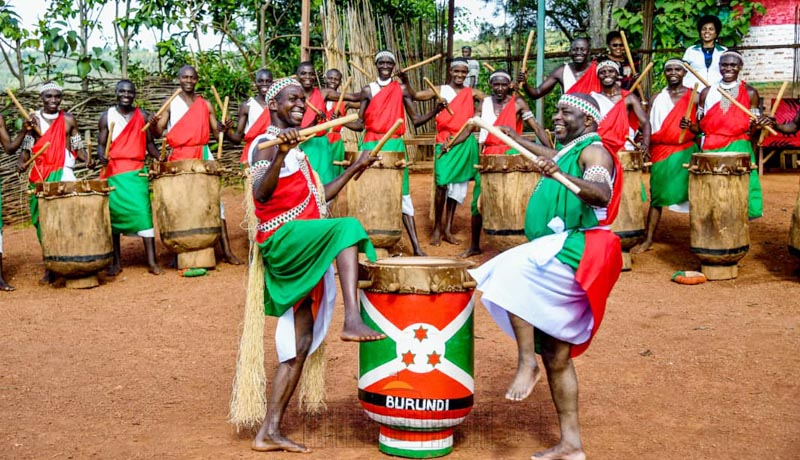
BURUNDI :For centuries, the Burundian drum has resonated and told stories. In the deep rumble of its rhythms and in the movements of the dance that accompanies it, the history, memory, and identity of a people come together. It is a major symbol of Burundian culture, a link between generations, and a language passed down through time.
In Burundian tradition, the ritual and institutional practice of drumming was historically entrusted to men, particularly the Batimbo, custodians of knowledge associated with this practice.
This tradition has its roots in the history of the royal drums, foremost among them the famous Karyenda. These drums occupied a central place in the Burundian monarchy. Associated with the legitimacy and continuity of royal power, the drums were governed by specific rules concerning their manufacture, preservation, transmission, and use.
The Batimbo, members of traditional guilds of ritualists and drummers, possessed the knowledge associated with the making, maintenance, and performance of the royal drums. Their role was part of a ritual system closely connected to shrines and the monarchy. Following the disappearance of the monarchy, the practice of drumming gradually spread throughout Burundian society. Numerous groups of drummers were formed. Nevertheless, percussion remained, within the tradition, essentially a male practice.
A Prohibition That Became Law
Although the distinction between men and women is longstanding in the traditional practice of drumming, it was also incorporated into Burundian law. Decree No. 100/0196 of October 20, 2017, regulating the use of drums at the national and international levels, sets out the conditions under which drumming groups may perform.
Article 3 is explicit and stipulates that “It is strictly prohibited for persons of the female sex to beat the drum; they may nevertheless perform traditional women’s dances accompanying the playing of the drum.”
The 2017 decree therefore did not, by itself, establish the distinction between men and women in the practice of drumming: it gave legal force to a prohibition that was already rooted in an older traditional conception. However, the question of women’s participation had already been the subject of debate in contemporary Burundi before the adoption of the decree.
“It is strictly prohibited for persons of the female sex to beat the drum; they may nevertheless perform traditional women’s dances accompanying the playing of the drum.” — Article 3 of the 2017 decree
From the Sacred to the Symbolic
To understand this distinction, it is necessary to return to the particular place occupied by the drum in traditional Burundian society. The Karyenda was associated with royal power and carried a strong ritual and symbolic dimension. The royal drum thus belonged to a world in which political power, beliefs, and the continuity of the monarchy were intertwined.
The drum is also associated with fertility. The traditional terminology used for several of its parts refers to the female body and motherhood: some are designated by terms evoking the breasts, the belly, the umbilical cord, or even the maternal crown.
These references testify to a feminine dimension in the representations associated with the drum. Nevertheless, they coexist with a traditional division of roles between men and women, with percussion reserved for men.
A Tradition Between Heritage and Change
Today, the drum remains one of the strongest symbols of Burundian cultural identity. Through drumming groups and performances organized both in Burundi and abroad, this practice continues to be transmitted and to gain international recognition.
The inscription of the ritual dance of the royal drum on the Representative List of the Intangible Cultural Heritage of Humanity has also contributed to giving this cultural expression international visibility. For UNESCO, it serves in particular as a means of transmitting knowledge, values, and messages from one generation to another.
Nevertheless, the role of women in this practice remains a sensitive issue. It fuels a debate between those who regard this distinction as a historical rule inherent to the tradition and those who believe that women should participate directly in this cultural expression. Emilie Nkengurutse, a former member of a women’s drumming group in Bujumbura, told The New York Times in 2022: “I miss the drum. I often go to performances, and sometimes I want to pick up the sticks and play, but I can’t.”
The issue concerns the way a society preserves its heritage while allowing its practices to evolve, and raises questions about the boundary between preserving a tradition and adapting it to social change. The role of women is now part of this broader reflection on how cultural heritage is transmitted, preserved, and transformed.
Source:Afrik.com — Article originally written by Faustin Kabanza, a committed thinker and columnist particularly attentive to sociopolitical, intellectual, and human issues related to Africa, especially Central Africa. A linguist and specialized educator by training, he is interested in the transmission of knowledge and the continent’s cultural and social dynamics.
TIDAS – Translation, Interpreting & Support for Your Asylum and Residency Procedures in France
Welcome to TIDAS (Translation, Interpreting, and Asylum & Residency Assistance in France).Our mission: to help foreigners in France overcome language barriers and administrative obstacles.
Our services:
Translation and interpreting for your appointments and documents
Support with asylum applications
Assistance with all your administrative procedures
With TIDAS, you benefit from a professional, caring, and reliable service.We believe that everyone deserves to be understood and supported.
Contact us today and let’s move forward together at (+33) 07 58 90 35 49 or email us at tidasetvous@gmail.com